The diversity of over 500 municipal companies places high demands on occupational safety. The team led by Roger Dörig, Head of the Occupational Safety and Health Protection Unit, and Günther Müller, ASGS specialist for the city of Zurich, has witnessed how the requirements for a digital work group solution have changed over the last 20 years.
Mr. Dörig, you are head of the ASGS Health Protection Zurich specialist unit. What is your main area of responsibility?
Roger Dörig: My main tasks include ensuring legal certainty and the further development of the company group solution, including its recertification, personnel management and budget responsibility as well as the strategic direction of the specialist unit. In technical terms, the BGL is subordinate to a body of the City of Zurich, which is mandated equally by employer and employee representatives. In terms of organization and budget, we are subordinate to the Department of Environment and Health Protection (UGZ). As a specialist unit, we are responsible for reporting on our activities to the sponsoring body and the Zurich City Council as a whole.
How did you come to set up your own specialist unit in the city of Zurich?
R.D.: In 2000, Zurich City Council decided to implement occupational health and safety in accordance with EKAS Guideline 6508. The core statement of the City Council's decision was: "The departments of the City of Zurich implement occupational health and safety in accordance with Directive 6508 - period." The ASGS specialist unit was then created, which developed a company group solution that was certified for the first time in 2002. Today, around 525 companies, or around 25,000 employees, are affiliated to BGL Stadt Zürich. A company group solution for the entire city is naturally more cost-effective than if each department had its own solution in use, whereby each company can join our BGL on a voluntary basis.
What particular challenges does the City of Zurich face?
R.D.: The biggest challenge is the broad spectrum of our affiliated companies - in terms of hazardous situations. Starting with the "simple" office workplaces, through activities at drug dispensaries to work in recycling companies. Not forgetting the city schools with around 120 school units or the public transport companies (VBZ) and many other companies such as Waste Disposal and Recycling (ERZ).
What impact does this have on communication with the companies?
Günther Müller: The question is always: Which area of our diverse customer segment is my contact from? Accordingly, the needs of a daycare center are very different from those of a workshop. The hazards in an office are different from those in a chemical room. The arguments have to be formulated differently depending on our customers' existing specialist knowledge. In other words, the main challenge lies in the diversity of our affiliated companies.
You opted for software for your operating group solution early on. What were the reasons for this?
G.M.: Before 2016, we were still using a purely paper-based solution. The customers had our BGL folder with content adapted to the company at their disposal. Keeping these up to date required a lot of time and effort. From our perspective, or rather from the perspective of an operating group solution, we never had a complete overview. We could only assess the implementation status of the respective customers on site. We were also experiencing steady customer growth. These reasons were decisive for us to switch to an electronic solution. At that time, there was no product on the market that met our requirements and expectations. We therefore took the step of having an application programmed that was suitable for our BGL. In less than ten months from the "kick-off meeting", we were able to provide our customers with a functioning, web-based solution. However, we underestimated the huge amount of work involved.
In the meantime, you have switched to a new software. How did this changeover come about?
G.M.: One of the main reasons for the switch was the rapid technological change. We would have had to "redesign" our existing tool from scratch anyway. The question of evaluating a new IT solution arose, as good tools were now available on the market. This allowed us to concentrate much more on the technical aspects again. Our previous tool was still a bit bumpy in terms of user-friendliness. This was also rightly criticized by our users. The change has resulted in a significant improvement in this respect.
Why did you finally opt for the "safely" web application?
R.D.: A meticulous evaluation was carried out prior to an invitation procedure. Our IT specialists at UGZ were on board and went through all the processes. One huge issue, for example, was the aspect of data security, which had to be coordinated with the Organization and Information Technology of the City of Zurich (OIZ). For example, they wanted to know exactly where which data would be hosted and backed up. The selection process also included financial criteria. It was a very extensive catalog on the basis of which the decision for a software was made. The entire evaluation took a good six months. Why the decision was ultimately made in favor of "safely" from Lobsiger & Partner GmbH also had to do with the high level of legal certainty. One positive point was that we never had to worry about the checklists, as Suva's original checklists, for example, are always updated. This means that we no longer have to verify checklists in advance. Since then, we can focus much more on our customers.
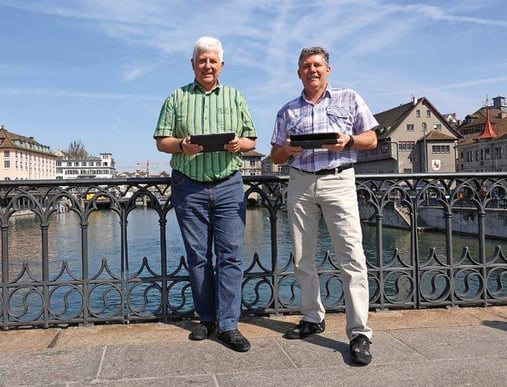
Swissness and legal certainty: for Roger Dörig (left), Head of ASGS, and Günther Müller, responsible for the introduction of "safely" in the companies of the BGL of the City of Zurich, decisive arguments for a modern company group solution.
How have the affiliated companies and users reacted to the change ?
G.M.: Basically, all the affiliated companies reacted very positively, as we were able to clearly show them that everything they had previously told us they wanted could now be implemented. From user-friendliness and legally compliant checklists to additional functionalities - suddenly everything was available in one fell swoop. In fact, there was a lot of positive feedback, just in terms of the individual functions.
How much training was required for the individual departments using the solution?
G.M.: In view of the possibilities offered by "safely", the effort required was relatively low. This is partly due to the fact that many things can also be done online. The input screens have a high recognition value, which simplifies operation and requires less time for training.
How can the specialist department benefit from "safely"?
R.D.: One advantage is the quick overview of the BGL in the "safely" infoboard: this allows areas for action to be identified very quickly. The human resources of the specialist unit can now be deployed more efficiently. Legal certainty is also a compelling argument. Innovation is also an important point for me and our customers. In addition, the cooperation with Lobsiger & Partner is very good.
How can companies benefit from "safely"? There are now so many providers stirring up the market.
R.D.: Indeed, but there are not many really good and holistic solutions. There are a few niche solutions. The aspect of "Swissness" or the location advantage was certainly an important argument. The direct line to the manufacturer was particularly important to us. If something goes wrong, you can send an e-mail and you will receive a reply within a reasonable period of time. This service was also a decisive factor for us.
Looking back, would you choose a solution like this again?
R.D.: Definitely. There is not much more to say.
Originally published in SAFETY-PLUS 2/22, page 12-13