Continuous improvement in the area of occupational health and safety is required by law. This also applies to cities and municipalities with all their administrative buildings, depots, sports and school facilities, as well as leisure facilities. Simone Enderli is Head of Internal Safety at the City of Zug and in this staff position is also responsible for standardizing processes and integrating personnel work.
Ms. Enderli, what are the most important principles and challenges in coordinating occupational safety and health protectionin a public state or municipal enterprise such as the City of Zug ?
Simone Enderli: The understanding of occupational health and safety is a question of corporate culture and should not only be anchored in the mission statement, but should also be lived and exemplified. In a public company, there are various stakeholder groups that have different needs and share different views. It is a major challenge to make these people individually aware of the importance of the topic and to win them over. Pulling together is essential if the issue is to be addressed and dealt with in a beneficial and relevant way.
What does a working day look like for you?
As Head of Internal Security, I have a staff function and am responsible for all properties in which employees of the City of Zug work. This includes not only administrative buildings, but also all school and sports facilities, leisure facilities, the music school and the library and, of course, our Werkhof and Ökihof. Above all, I make sure that as much as possible is standardized, simplified, process-oriented and conceptually structured, as well as organizationally stored and documented.
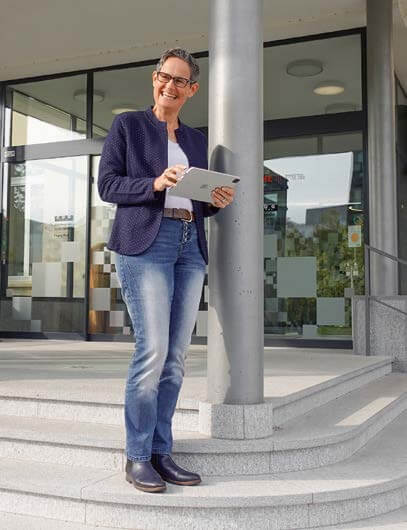
Simone Enderli, Head of Internal Security at the City of Zug, relies on a digital ASGS solution. (© Simon Gröflin)
What are the typical tasks?
These include, for example, ensuring that the emergency concept is in place and that escape and rescue plans are drawn up and kept up to date, as well as training on evacuation procedures and carrying out drills. I also launch health campaigns and evaluate and introduce aids such as defibrillators and first aid equipment. I provide advice and support to the line in the staff unit. Occupational accidents and illnesses are also clarified and documented. We are supported in many tasks by the "safely" software, which was purchased specifically for this purpose.
What special features characterize the city of Zug and its trades compared to other municipalities?
In my role, I report directly to the Head of Human Resources. Only the Werkhof/Ökihof has its own health and safety officer, who acts as an extension of my staff unit and takes on the work that needs to be done in the area of occupational health and safety. All of our janitors act as area safety officers (BeSiBe). With their local knowledge and responsibility, they support the safety officer and take on the basic and operational tasks in this area, such as investigating hazards or reporting defects.
Which operational tasks and needs have been well or less well integrated into your day-to-day workso far?
Sometimes it seems as if it is easier to motivate those involved for a task if it is as simple as possible, hardly ties up any resources or the work can be delegated further. However, not everyone involved is always aware of their responsibility and role. This always requires real persuasion. The easier something is to do, the better.
The model solution from Lobsiger & Partner is a great support for us, especially when it comes to cross-departmental coordination, but also for the overall commissioning of inspections and hazard identification, such as checking escape and rescue routes, work equipment in workrooms or the condition of ladders in the depot. It is also the easiest way for us to call in occupational safety specialists. The prompt implementation of orders is still heavily dependent on resources and the budget process. However, this is often due to a lack of understanding and resources. The efficient implementation of defined measures depends heavily on the budget process and often requires patience during implementation.
Speaking of resources: how do you manage all of this in your workload?
With my 70 percent workload, I am indeed working at full capacity and have to manage my tasks and resources well. You can't do this without setting priorities. You have to stay organized and flexible. It happens time and again that annual targets have to be adjusted because unforeseen projects come up - or a pandemic turns everything upside down, shifting the workload.
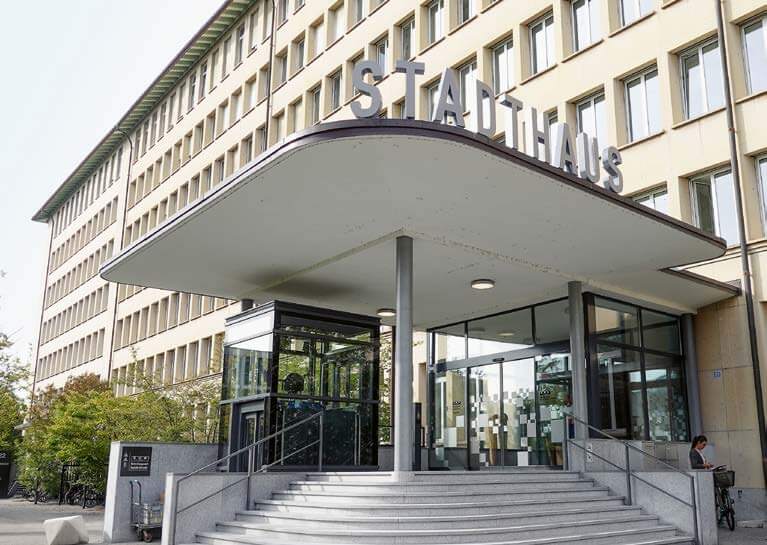
The city administration of Zug comprises over 80 buildings and various leisure facilities with occupational safety requirements. (© Simon Gröflin)
This task requires a great deal of specialist knowledge. What helps you to successfully implementthe 10 points of the ASA guideline?
I see myself more as a generalist who knows where she can get her specialist information internally and externally. It is particularly important to me to only pass on well-founded information, preferably in writing. In order to comply with EKAS Directive 6508, we decided to connect to the model solution from Lobsiger & Partner, which takes a modern approach with the "safely" web application. This application is already designed for the 10-point ASA system and is clearly structured. In addition, it already contains a lot of documentation, instructions, directions and leaflets that provide me with specialist information or are available as ready-made forms.
Why did you opt for a digital ASGS solution?
I am generally interested in a standardized and simplified way of working. Even the first jobs, for example when the specialist teachers were recording work equipment in the workrooms, showed that this was the case: The "safely" system is largely self-explanatory and intuitive to use. A short guide with screenshots is usually sufficient, and personal system training can be dispensed with in some cases, as not all of our users are PC-savvy and equally aware of their responsibility as SiBe/BeSiBe. For this reason, we have to be able to convince them through simplicity. This has been proven by "safely".
How did the partnership with Lobsiger & Partner come about and what do you particularly appreciate about this collaboration?
I first came into contact with Lobsiger & Partner GmbH over ten years ago. I appreciate the direct and uncomplicated exchange and the specialist know-how. With "safely", I also get software from a single source, which makes collaboration even easier.
Would you go down this route again - or recommendyour concept to other SiBe colleagues and municipalities?
At the moment, "safely" is the most convincing way for me to meet the legal requirements on the one hand and to support users in a simple and needs-oriented way on the other. The data entered is available anywhere and at any time on the web. It is a huge advantage to be able to store entire modules from areas such as training and further education or maintenance of machines and equipment with a processing rhythm and to be informed early and automatically by e-mail about upcoming work. In addition, the system also provides up-to-date data for analysis and statistics, which is required for budgeting and investment issues.
From what size of company is the solution you use suitable?
Even for small organizations with different work areas and a variety of needs, "safely" offers an excellent opportunity to record data efficiently and easily, to process the measures,
responsibilities and finally to keep an overview in a structured and organized way. I can only recommend the product and the collaboration with Lobsiger & Partner.
Originally published in SAFETY-PLUS 4/21, page 14-15